Welcome to On My Bookshelf, a corner of this site where I share the books, ideas, and frameworks that offer a clearer map for your personal and professional growth. I am often asked by clients what I am reading, or what resources might help them navigate a high-stakes transition, a team breakdown, or a season of feeling quietly stuck. While no single book holds all the answers, I believe the right perspective at the right time can give us language for things we have felt for a long time but couldn’t quite articulate.
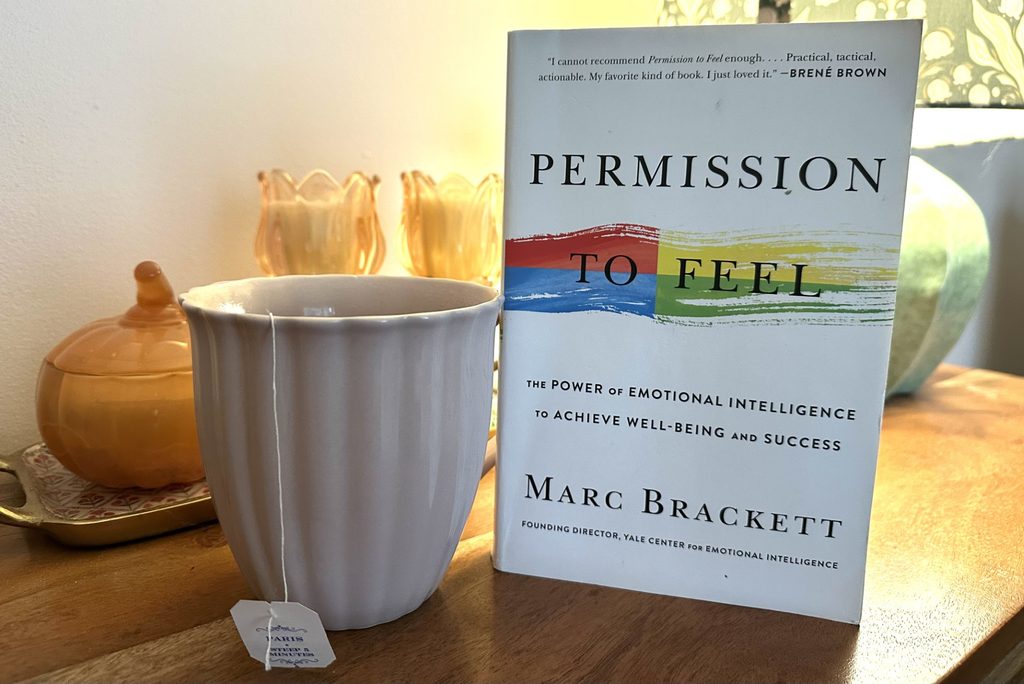
That is why I am kicking off this series with a book that has deeply influenced both my coaching practice and my own life: Permission to Feel: Permission to Feel: The Power of Emotional Intelligence to Achieve Well-Being and Success by Dr. Marc Brackett.
The Exhaustion of “I’m Fine”
Picture a typical week in your life. You spend your days making key decisions, managing responsibilities, and keeping life moving smoothly. When someone asks how you’re doing, your response is swift and practiced: “Busy, but good!” or “Just pushing through.”
To everyone around you, you have it completely together. But under the surface, you might be carrying a persistent weight, frustration from a difficult team dynamic, anxiety about an upcoming transition, or a subtle sense of overwhelm that you can’t quite shake. So, you do what high-achievers are taught to do: you push it down, intellectualize it, and tell yourself to stay focused.
Eventually, there comes a moment when that default strategy stops working. Maybe it’s a sudden wave of exhaustion after a long work week, a moment where you lose your patience over something small, or a quiet Sunday night where you realize you have been running on empty for months. You realize that ignoring how you feel isn’t making the feeling disappear. It’s just draining your energy.
From Emotion Judge to Emotion Scientist
When those uncomfortable emotions surface, most of us instinctively judge them. We tell ourselves, “I shouldn’t feel anxious about this project,” or “I ought to be grateful, not frustrated.” We treat our internal state like a flaw to hide or a problem to solve immediately. Navigating that gap between how you think you should feel and how you actually feel is exhausting, leaving you disconnected from yourself and unsure of how to move forward with real clarity.
What if your feelings were never problems to fix, but valuable data?
Dr. Marc Brackett, founding director of the Yale Center for Emotional Intelligence, offers a simple yet profound shift: what if you stopped being an “emotion judge” and became an “emotion scientist”?
When you step into the role of an emotion scientist, anxiety, frustration, or overwhelm are no longer personal failures. They become neutral data points. Your body and mind raising a flag to say, “Pay attention here. Something matters to you.” Moving past broad labels like “stressed” or “fine” to name what you actually feel, whether it is unappreciated, uncertain, or overwhelmed, calms your nervous system and shows you exactly what boundary or support you need. Through Brackett’s RULER framework (Recognizing, Understanding, Labeling, Expressing, and Regulating), you give yourself space to feel without letting the emotion drive your decisions.
Cultivating Space and Clarity
Imagine waking up to a challenging day at work or a complex dynamic at home and no longer wasting energy trying to suppress how you feel. Instead of fighting your internal landscape, you recognize it, name it clearly, and use it as fuel for grounded, clear decision-making. You stop judging yourself for being human and in doing so, you unlock a deep sense of trust and alignment in your career and life. As you move through your work and conversations this week, notice where you might be judging a feeling rather than simply allowing it space. When an uncomfortable emotion arises, take a slow breath and ask yourself gently:
“If this feeling were just neutral information, what would it be trying to tell me right now?”
If you’ve read Permission to Feel or have a favorite book that has helped you navigate your own moments of growth, I would love to hear about it. Feel free to reach out and share your thoughts via my contact page.